
Automatic Water Pump Controller
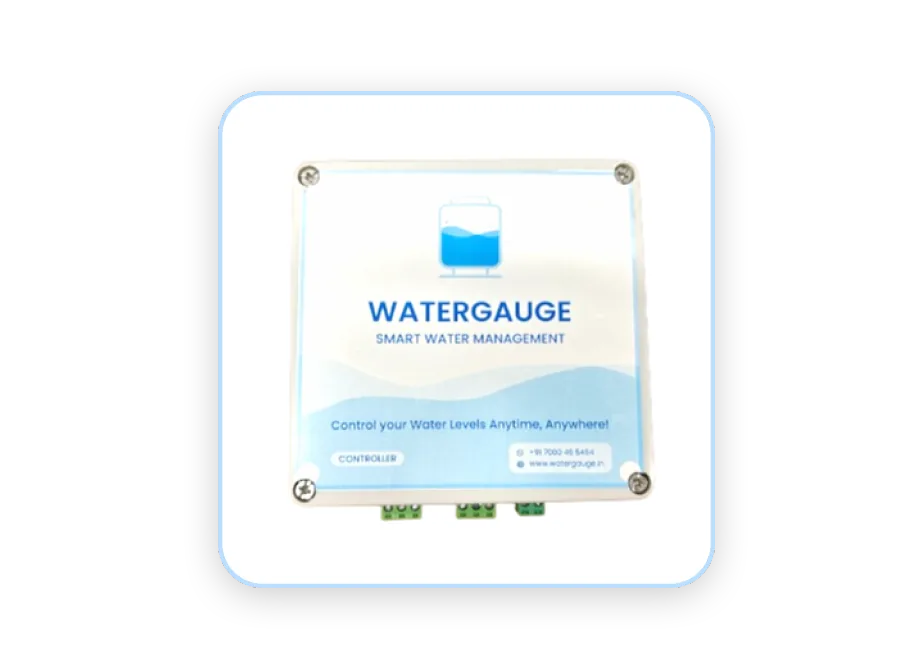
The controller is the motor half of Water Gauge wireless automation.
Step 1 - Site Selection :
- Choose an installation location for the control unit that is easily accessible and close to the motor starter.
- Ensure the control unit is placed in a location protected from environmental conditions (water, dust, etc.).
Step 2 - Connecting the Control Unit :
- Connect the control unit to an AC power source using the included power adapter.
- Ensure the control unit is securely mounted in a dry and safe location.
Step 3 - Connecting the Control Unit to the Motor Starter :
- Connect the control unit to the submersible motor's starter using the provided relay connections.
- Ensure that the wiring is properly connected to the relay output, with all connections secure.
- Follow the manufacturer's instructions to connect the control unit to the motor starter, ensuring compatibility with the system.
- Verify the connection between the control unit and the motor starter to ensure correct operation.
For relay-based systems :
For other motor starter systems :
Step 4 - Connecting the Control Unit to the Android App :
- Download and install the corresponding Android app for controlling the motor starter (provided by the device manufacturer).
- Open the app and pair it with the control unit following the on-screen instructions.
- Ensure the app can communicate with the control unit by checking the connection status.
Step 5 - System Power-Up and Testing :
- Power on the system by connecting the control unit to the AC power source.
- From the Android app, manually test the control unit to turn the motor on and off.
- Verify that the motor starter responds to commands from the app by turning the submersible motor on and off as expected.
- Perform a final test to ensure that the system is functioning properly under both manual and automatic control from the Android app.
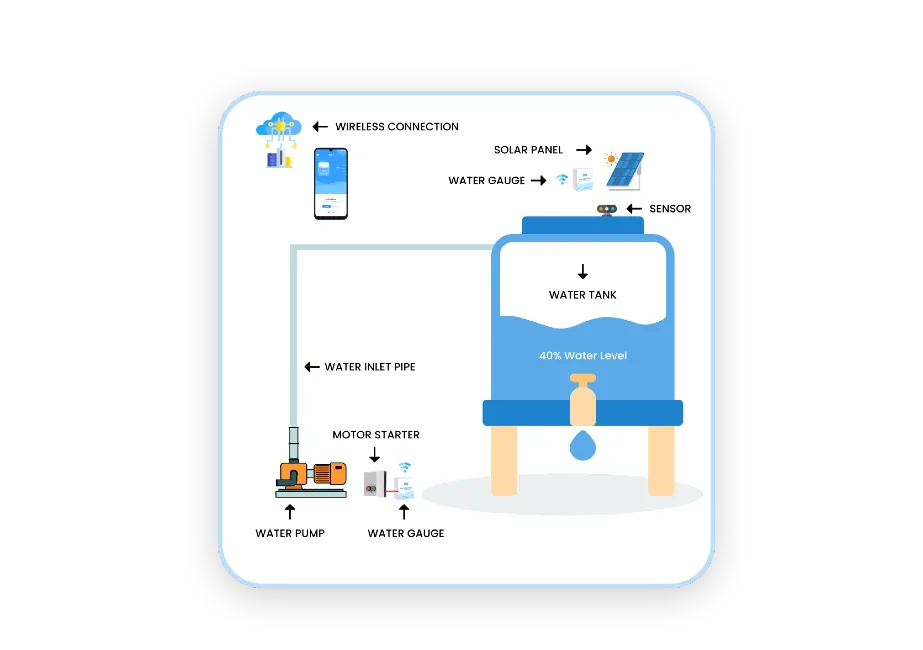
How It Functions
The primary purpose of the Water Gauge project is to provide an efficient, reliable, and eco-friendly solution for water management. This system aims to:
 Solar-Powered Devices
 Wireless Communication
 Real-Time Monitoring
 Remote Control
 Automate Water Control
 Save Water
 Cost Savings
 Eco-Friendly
 Water Conservation
 Support